Thursday, January 25, 2024

Simple & Developer-friendly Python Monorepos

🎉 Announcing new features 🎉

Polylith is about keeping Monorepos Simple & Developer-friendly. Today, the Python tools for the Polylith Architecture has support for Poetry, Hatch and PDM - three popular Packaging & Dependency Management tools in the Python community.

In addition to the already existing Poetry plugin that adds tooling support for Polylith, there is also a brand new command line tool available. The CLI has support for both Hatch and PDM. You can also use it for Poetry setups (but the recommended way is to use the dedicated Poetry plugin as before).

To summarize: it is now possible to use the Simple & Developer-friendly Monorepo Architecture of Polylith with many different kinds of Python projects out there.

"Hatch is a modern, extensible Python project manager."
From the Hatch website

🐍 Hatch

To make the tooling fully support Hatch, there is a Hatch build hook plugin to use - hatch-polylith-bricks - that will make Hatch aware of a Polylith Workspace. Hatch has a nice and well thought-through Plugin system. Just add the hook to the build configuration. Nice and simple! The Polylith tool will add the config for you when creating new projects:

[build-system]
requires = ["hatchling", "hatch-polylith-bricks"]
build-backend = "hatchling.build"
"PDM, as described, is a modern Python package and dependency manager supporting the latest PEP standards. But it is more than a package manager. It boosts your development workflow in various aspects."
From the PDM website

🐍 PDM

Just as with Hatch, there are build hooks available to make PDM aware of the Polylith Workspace. Writing hooks for PDM was really simple and I really like the way it is developed. Great job, PDM developers! There is a workspace build hook - pdm-polylith-workspace - and a projects build hook - pdm-polylith-bricks - to make PDM and the Polylith tooling work well together.

This is added to the workspace build-system section pyproject.toml:

[build-system]
requires = ["pdm-backend", "pdm-polylith-workspace"]
build-backend = "pdm.backend"

And the plugin for projects.
This will be added by the poly create project command for you.

[build-system]
requires = ["pdm-backend", "pdm-polylith-bricks”]
build-backend = "pdm.backend"
"Python packaging and dependency management made easy."
From the Poetry website

🐍 Poetry

For Poetry, just as before, add or update these two plugins and you're ready to go!

poetry self add poetry-multiproject-plugin
poetry self add poetry-polylith-plugin

📚 Docs, examples and videos

Have a look at the the Polylith documentation for more information about getting started. You will also find examples, articles and videos there for a quick start. I'm really excited about the new capabilities of the tooling and hope it will be useful for Teams in the Python Community!


Top photo made with AI (DALL-E) and manual additions by a Human (me)

Tuesday, December 19, 2023

The Lost Balkan Tapes: a Christmas story

A couple of days ago, a nice thing happened that has made me very happy. It happened almost by accident. At work, we have a #music channel on Slack and some of us frequently share music that we like and recommend to the folks in the company. I really like those kind of work-but-not-related-to-the-actual-work kind of things. It helps developing a friendly Organizational culture, and it is also a simple way to get to know each other better.

Background

I was born and raised in the Stockholm area of Sweden, but my dad and his parents (my grandparents) came to Sweden in the late 1960s from former Yugoslavia. They, like many from the Balkans, Finland, Italy and Greece, got job offerings from Swedish companies and they decided to give it a try. They began working with manufacturing chocolate here in Stockholm. I don't know that much about their life over there before Sweden, other than the stories I've heard many times when growing up.

One of my favorite stories is about my Grandfather and when he escaped from some kind of prison camp, set up by the World War II Occupation of former Yugoslavia. He was only a teenager back then, but managed to run away from the guards into a forest - and then catch a passing train, on its way away from the camp. In my imagination, the train was moving fast and he jumped on it in the same way Indiana Jones would do. I remember him telling me and my brother about going undercover, calling himself Ivan Something-something when the train conductor asked who that kid from nowhere was. I loved that story and wanted to hear it over and over again.

Another favorite story was about my Grandmother. She used to be a singer in the 1950s, early 1960s and performed all over the country. I remember the day she told me about the famous people she used to sing for, such as the Ethiopian Emperor Haile Selassie! When I grew up, Reggae and the Rastafari culture was a big thing among us kids in the suburbs, and I certainly knew about Haile Sellasie. My grandma has not only met him, but also has sung for him! Wow. As I understood it, she was popular and during a period of time she was often hired to sing when the officials of the Country expected a visit from abroad.

I have heard only a few songs on cassette when we hang out in the apartment in Fisksätra (a concrete suburb in the Stockholm area that I have spent a lot of time in). I remember the music sounding quite good. But honestly, as a kid and later a young adult, I wasn't really that much of a fan of Balkan Folk Music. Still very cool to hear her sing. She occasionally sang some songs for us too, but time & smoking cigarettes had made her voice different than from the recording of those cassette tapes.

Years later, with both grandma and grandpa no longer around, I thought that the tapes were lost & gone forever. If I recall it correctly, some of it was even accidentally overwritten. Oh no. I made some attempts to find information (and possibly music) online, but failed. I gave up hope of finding anything. This was many years ago.

Today

Back to work. I decide to share some nice Reggae music in the Slack channel. I found the Gratitude Riddim when browsing my online music app, good stuff! The friends at work got inspired and also shared some Jamaican vibes and we had a fun conversation going on there. Then, one person added a picture of Haile Selassie that took me right back to those childhood memories. So, naturally, I told them the Story about my Grandmother and that she has sung for him. But sadly the music is gone, you know. My friend probably got curious, and I believe he just googled her name.

”Wow, very cool to hear about your grandma. Is this her?”
(with a link containing music)

What?

What? Huh? No, wait. That can't be her. Or. Is it? Naw. Gotta be someone else. Then again, how many Folk Music singers from the Balkans named Ikonija Vujic can there be? After a while, I realized that it is in fact my Grandmother! He actually found about 15 songs. All of them beautiful & melancholic Love Songs. Old school Balkan Folk Music with the Tamburitza instrument. Is it the great Janika Balaž playing? This is just me guessing, but according to Wikipedia he lived in the exact same area where my grandparents (and my dad) used to hang out back in the days. They must have met sometime!

I can't think of a better Christmas gift than this and I am forever grateful about these findings. It happened almost randomly, by accident. If I hadn't shared those Reggae songs in Slack, I would still be thinking that the music of my Grandmother was gone. But the Lost Balkan Tapes of Ikonija Vujic have been found again. Thanks to my friend at work and the enthusiast person that has published a huge amount of Balkan Music from the past. Thank you! 🙏

Wednesday, November 15, 2023

A Coding Copilot

When developing software, I spend most of the time thinking & talking about the problems to solve: the what, the why and the how. The thinking-part works best for me when I'm actually away from the desktop, such as walking outdoors or even when grabbing a cup of coffee & a banana by the office kitchen. 🍌

Talking is a really nice thing, we should try that more often in combination with listening to what others have say. Even when not having any human around to chat with, there is always the rubber duck. Speak to it!

Problem Solving

Mob programming takes the Thinking & Talking to the next level. I am, strangely enough, surprised almost every time how great mob and pair programming is for software development. I tend to forget that. It's probably easy to fall back into old familiar behavior.

When figuring out what to try out, the actual typing is done pretty fast for me. A big part of the productivity boost is inspiration and the joy of solving problems with programming. I think this is valid for most creative and problem-solving work.

Everyday practicing

I try hard every day to write clear & concise code. Practicing, learning ... and walking. I really like the Functional approach to programming: separating data from behavior, actions from calculations. I should probably use GitHub Copilot or ChatGPT more, but haven't yet found the need to go all-in (aren't the AI suggestions a bit verbose, or am I doing things wrong?). Those types of in-editor copilots are cool, definitely, and are for sure here to stay. Currently, I find more value in a different kind of automated guidance.

CodeScene

When working on my Open Source Project, the Python tools for the Polylith Architecture, I am guided by tools like SonarCloud and CodeScene. I guess there are some AI involved quite heavily in there too. I especially appreciate the code reviews & even more the CodeScene long-term analysis about the effects of Tech Debt. It's like having a co-pilot, or even a Teacher, guiding you during the development to make you a better software developer than before.

This is different from the kind of review a team of humans usually do when sharing feedback on Pull Requests or even during mob programming sessions.

Even if I sometimes disagree with things the tools report on being a problem, I go ahead and refactor the code anyway. Then, when doing the refactoring, I quickly realize that the code is actually transforming into something simpler and clearer than before. SonarCloud is more into the low level details, and lets me know about code duplications or code smells. We don't want that, no. Better fix that too.

Coding Style

The feedback from these kind of tools is helping me to get closer to writing the type of code I want to write: minimalistic, readable and functional. A coding style that also is a very good fit for the Polylith Architecture, even if that thing isn't about how the code is written. You are encouraged to write in a readable & functional style by the structuring of code and by having all code at your fingertips, ready to experiment with in the REPL or in a Notebook.

CodeScene, SonarCloud and Polylith: all of them helping me in my journey to be a better Developer. Maybe I'll throw in Copilot in there too eventually.

Top Photo by Jamie Templeton on Unsplash

Saturday, September 30, 2023

Software and Projects

How can we simplify things, to add value as early as possible?

Software Projects is a misconception within Software Development. When organizing work into Projects, one might think that there also is a need to estimate the things to be done. Because the Project itself is by definition something that will end, or more likely be delayed.

From my experience, estimation is only adding anxiety and sometimes actually delaying value. I have experienced the same thing with Projects and fixed release dates.

Instead, we could flip it: how can we simplify, to add value for our users as early as possible?

Flip it!

In a team that I was part of some time ago, the Product Managers challenged us by asking those kind of questions. We (the Developers) were at the beginning intimidated, because we had the idea of building the perfect kind of feature and usually we spent time on figuring out & cover as many scenarios as we could imagine. The not-great thing with that approach is that it will likely increase the cost, because it would take longer time and more effort to deliver value for the users of the product.

Think Different

The Product Management folks kept challenging us to think different, and we begun to find ways of delivering smaller parts of the product within days (instead of months). We wouldn't be able to release an entire feature, of course. Far from it. Instead, it would be something - sometimes just a tiny addition - that people could use to simplify their daily work life. They actually did that, we saw it ourselves. There was value added, within a couple of days of development!

Smaller parts

There was no need for us (the Dev Team) to put any Fibonacci numbers or estimating hours to the tasks we identified should be developed. We stopped doing those stressful Big Bang Releases of huge chunks of code. Instead, we found ways to simplify tasks - splitting them out into several smaller parts - to make it possible to push the work to production within days. In my opinion, Projects, Estimation and Deadlines are rarely adding value. Why are there so many Organizations out there still doing that?

Top photo by Patrick Fore on Unsplash

Thursday, August 3, 2023

Kafka messaging with Python & Polylith

This article isn't about Franz Kafka or his great novella The Metamorphosis, where the main character one day realizes that he has transformed into a Human-size Bug.

It is about a different kind of Kafka: Apache Kafka, with examples on how to get started producing & consuming messages with Python. All this in a Polylith Monorepo (hopefully without any of the bugs from that Franz Kafka novella).

This article can be seen as Part III of a series of posts about Python & Polylith. Previous ones are:

  1. GCP Cloud Functions with Python and Polylith
  2. Python FastAPI Microservices with Polylith

If you haven't heard about Polylith before, it's about Developer Experience, sharing code and keeping things simple. You will have all your Python code in a Monorepo, and develop things without the common Microservice trade offs. Have a look at the docs: Python tools for the Polylith Architecture

Edit: don't know what Kafka is? Have a look at the official Apache Kafka quickstart.

I will use the confluent-kafka library and have read up on the Confluent Getting Started Guide about writing message Producers & Consumers.

The Polylith Architecture encourages you to build features step-by-step, and you can choose from where to begin. I have an idea about producing events with Kafka when items have been stored or updated in a database, but how to actually solve it is a bit vague at the moment. What I do know is that I need a function that will produce a message based on input. So I'll begin there.

All code in a Polylith Workspace is referred to as bricks (just like when building with LEGO). I'll go ahead and create a Kafka brick. I am going to use the Python tooling for Polylith to create the brick.

Note: I already have a Workspace prepared, have a look at the docs for how to set up a Polylith Workspace. Full example at: python-polylith-example

The poly tool has created a kafka Python package, and placed it in the components folder. It lives in a top namespace that is used for all the bricks in this Polylith Workspace. I have set it to example here, but you would probably want an organizational name or similar as your top namespace.

bases/
components/
  example/ 
    kafka/
	  __init__.py
	  core.py

There's two types of bricks in Polylith: components and bases. A component is where you write the actual implementation of something. A base is the entry point of an app or service, such as the entry point(s) of a FastAPI microservice or the main function of a CLI. In short: a base is a thin layer between the outside world and the components (containing the features). I will develop the base for my new Kafka feature in a moment.

A Producer and a Consumer

For this example kafka component, I will use code from the Confluent Python guide (with a little bit of refactoring).

def produce(topic: str, key: str, value: str):
    producer = get_producer()

    producer.produce(topic, value, key, callback=_acked)

    producer.poll(10000)
    producer.flush()

Full example at: python-polylith-example

I'll go ahead and write a message consumer while I'm at it, and decide to also put the Consumer within the kafka component.

def consume(topic: str, callback: Callable):
    consumer = get_consumer()

    consumer.subscribe([topic])

    try:
        while True:
            msg = consumer.poll(1.0)

            if msg is None:
                continue

            if msg.error():
                logger.error(msg.error())
            else:
                topic, key, value = parse(msg)
                callback(topic, key, value)
    except KeyboardInterrupt:
        pass
    finally:
        consumer.close()

The kafka component now looks like this after some additional coding & refactoring:

kafka/
  __init__.py
  consumer.py
  core.py
  parser.py
  producer.py

Running a Kafka server locally

I continue following along with the Confluent guide to run Kafka locally, and have added a Docker Compose file. I am storing that one in the development folder of the Polylith workspace.

development/
  kafka/
    docker-compose.yml

I can now try out the Producer and Consumer in a REPL, making sure messages are correctly sent & received without any Kafkaesque situations (👴 🥁).

Producing a message

I already have a messaging API in my python-polylith-example repo, with endpoints for creating, reading, updating and deleting data. This is the acual service that I want to extend with Kafka messaging abilities. The service is built with FastAPI and the endpoints are found in a base.

base/
  example/
    message_api/
       __init__.py
       core.py
@app.post("/message/", response_model=int)
def create(content: str = Body()):
    return message.create(content)

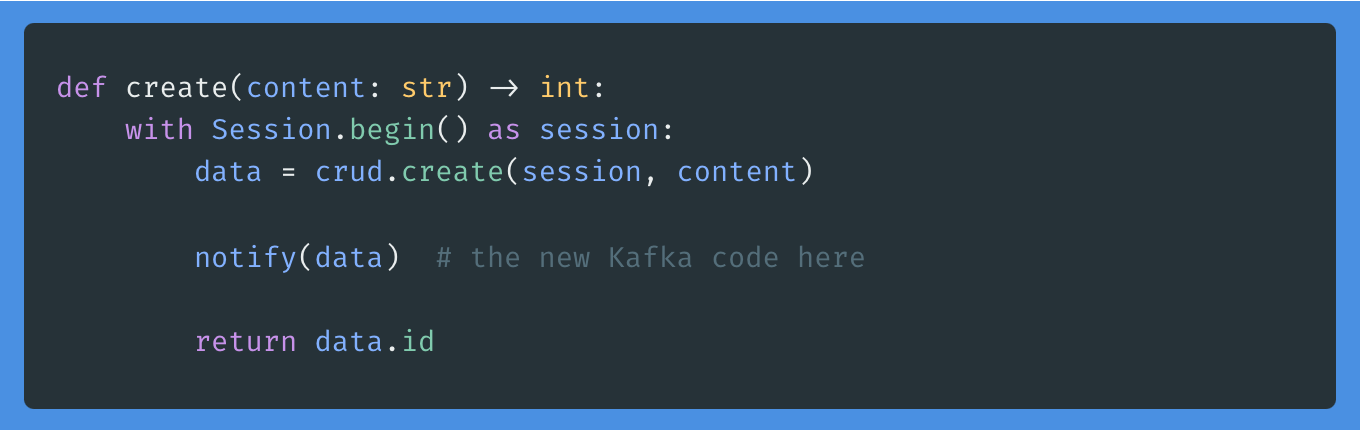
I'll continue the development, by adding the newly created kafka component. While developing, I realize that I need to transform the data into simple data structures - and remember that I already have a component that can be used here. This is where Polylith really shines: developing these kind of smaller bricks makes it easy to re-use them in other places - just by importing them.

Consuming messages

I have the kafka component with a consumer in it, and now is the time when I create a new base: the entry point for my kafka consumer.

This is the code I add to the base. Note the re-use of another already existing Polylith component (the log).

from example import kafka, log

logger = log.get_logger("Consumer-app-logger")


def parse_message(topic: str, key: str, value: str):
    logger.info(f"Consumed message with topic={topic}, key={key}, value={value}")


def main():
    topic = "message"
    kafka.consumer.consume(topic, parse_message)

Adding a project

I now have all code needed for this feature. What is left is to add the infrastructure for it, the actual deployable artifact. This command will create a new entry in the projects folder.

projects/
  consumer_project/
    pyproject.toml

I'm adding the dependencies and needed packages to the project-specific pyproject.toml file. But I am lazy, and will only add the base in the packages section - and then run poetry poly sync. It will add all needed bricks for this project. The poly tool has some magic in it, yes.

When deploying, just use the build-project command to package it properly without any relative paths, and use the built wheel to deploy it where you want it running. That's all!

In this article, I have written about the usage of Polylith when developing features and services, and Kafka messaging in specific. Adding new features & re-using existing code is a simple thing when working in a Polylith workspace. Don't hesitate to reach out if you have feedback or questions.

Additional info

Full example at: python-polylith-example
Docs about Polylith: Python tools for the Polylith Architecture

Top photo by Thomas Peham on Unsplash