
Showing posts with label shadow-cljs. Show all posts

Wednesday, December 22, 2021

Simple Component Driven ClojureScript

That Component Driven thing

Component Driven is about developing user interfaces and apps in a certain way. In short, it is about grouping relevant code into components, combining compontents into features, combining features into views (or pages) - and combining the views into an app. I don't think it should be that much about the tools.

Just like Test Driven Development, Component Driven Development encourages us to start small. In a way, it also reminds of LEGO when combining building blocks into something useful.

As your app grows and the coding is done deeper into the app structure, developing user interfaces might be more of a challenge. Finding the spot where a new feature is to be added, might require some clicks and navigation. You know, stuff like logging in, a specific app state - or even waiting for data fetched from a third party service.

This is when the idea of Component Driven Development is really useful. To simplify and speed up the development, we need something simple to host our components. A UI that is isolated from any app specific state or dependencies. A place where a component can be rendered without the need to set things up. Having that, it is possible to develop a component in isolation and test it with different input.

Do I need a tool?

Storybook is a tool that will solve all of this, with a bunch of other really nice things like docs, previews, example usage, variants, code snippets and viewports. But it is possible to try out the Component Driven style of creating user interfaces, without going all-in with a new tool.

Start small

I’m suggesting a very simplistic approach, that will enable rendering components in a short-lived isolated view. You throw it away when done.

Here, I’m using shadow-cljs and have defined a new alias that is targeting a browser. I have also set entry points. A setup almost identical to the web app alias. This one will run in a separate port and the output is compiled to a separate public folder. In that one, I have copied the HTML template from the public folder used by the web app.
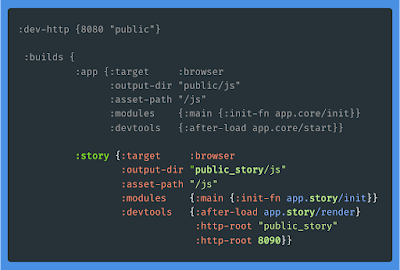
Click to enlarge the image, or browse an example gist here.

Keep it Simple

The entry point here is a simplistic and simplified version of the one used in the actual web app. But this entry point does only care about the component you are developing right now. Here is where you render and try out a component during development. This is a temporary place to work Component Driven. It’s almost like when evaluating code in a REPL, but with HTML and compiled JavaScript in a browser.
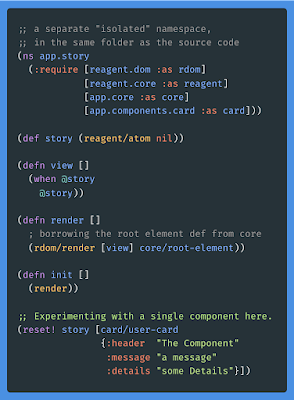
Click to enlarge the image, or browse an example gist here.

Run both aliases. The App in one browser folder, the component in a different one.
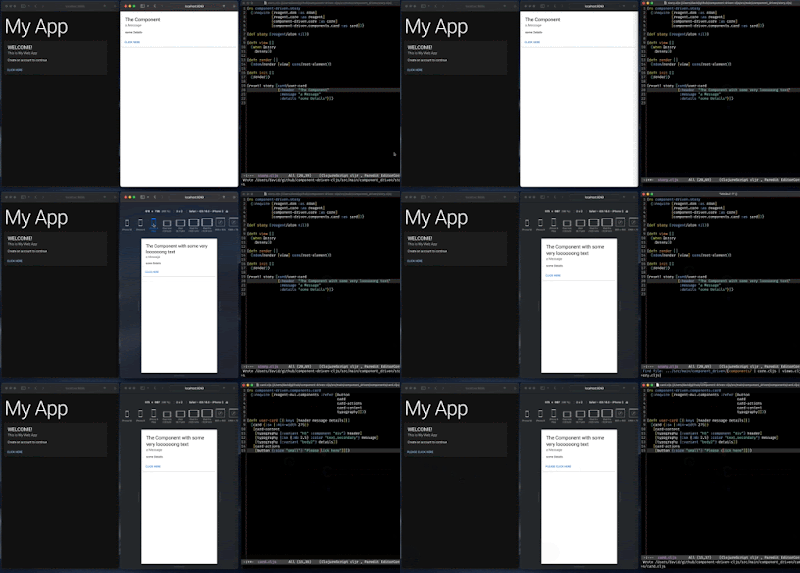
The browser is a powerful tool, with nice developer features.

Take it to the next level

At some point, you will probably want something more long-lived than this very simplistic scratch-style approach. That’s where Storybook fits in!

Component Driven ClojureScript with Storybook

With Storybook, you can focus on styling, different viewports and UI events when developing a single component. You write "stories" (i.e. running components in isolation), including documentation and lot of in-browser interactivity. The stories & docs can also be shared, by deploying it as a separate web app.

Recently, I talked about getting started with Storybook at the re:Clojure 2021 conference.

In this less than 25 minutes talk, I demo how you can use Storybook in your ClojureScript app and work Component Driven.

I hope you’ll like it!

Direct link to the Component Driven ClojureScript with Storybook video.


Top photo by Brett Jordan on Unsplash

Tuesday, August 31, 2021

Component Driven ClojureScript with Storybook

Component Driven?

Start small. Develop components in isolation. Don’t forget to pause & reflect on the code you’ve written. Can it be split into several small components?

✨ When you’re ready, combine your components to create features.

✨ Add the features to a view.

✨ Add the view to your app.

You can read more about Component Driven User Interfaces here.

Storybook

I’ve just begun to use Storybook and currently learning about it. What I especially like so far, is that the tool encourages you to write UI components that are independent … and functional?

This makes it possible to develop user interfaces in isolation. Just pass data and actions as parameters into your components. Keep it simple. This way of working reminds me a lot of Polylith, an architecture I have used in backend focused Clojure projects and that I enjoy a lot.

ClojureScript & Storybook?

You will find a fully working example in this repo. I have added Storybook to a ClojureScript web app, using shadow-cljs, with additional npm scripts located in package.json.

Update: a new version of shadow-cljs supports ns-regexp for the npm-module target. No need to manually add new stories!

The code in my GitHub repo is a continuation of the work I’ve described in an earlier post, about combining shadow-cljs with Webpack and AWS Amplify.

The Clojure Interactive REPL and Storybook working well together.

No JavaScript quirks?

Well, yeah some. The JavaScript ecosystem is evolving fast, tools are updated with breaking changes and sometimes that causes compatibility issues. In this case it is Storybook and Webpack 5. But I have solved it with a few extra rows of configuration. Don’t worry.

An example of a Storybook story written in ClojureScript

Have a look at the fully working example at GitHub.

Many thanks to Shaolang Ai, that wrote this blog post about shadow-cljs and Storybook that I’ve learned a lot from.


Top photo by Etienne Girardet on Unsplash

Sunday, August 29, 2021

Hey Webpack, Hey ClojureScript

✅ ClojureScript is great.

✅ AWS Amplify is great.

🤔 Why are there errors in my browser console?

ClojureScript. Amplified.

Some time ago, I decided to give AWS Amplify a try for a new project. With Amplify, you can quickly create and deploy web apps and AWS backend services by using your command line.

Even though the Amplify code examples and docs are all about JavaScript, I wasn't too keen on abandoning my favorite REPL powered language: Clojure. 🤩

So, I decided to combine two great things: AWS Amplify & ClojureScript!

Amplifed, yes. But with 🔔.

I have learned a lot from this blog post by Robert J Berger about how to setup AWS Amplify with ClojureScript. New versions of the AWS Amplify libraries are released regurarly. The current Major version include breaking changes that probably will cause ClojureScript web apps to raise errors and stop working.

Until recently, I have had to rollback updates and use earlier versions of the Amplify libraries. Nothing wrong with that. But my inner Alarm Bells have been ringing constantly since noticing the word legacy in the official Amplify docs for those library versions (the aws-amplify-react library and the Amplify Auth feature in particular).

The newer Amplify libraries rely on Webpack specific features under the hood. The example setup described in the official Amplify docs include using react-scripts, that (if I'm not mistaking) will package code with Webpack. That kind of setup is not supported by shadow-cljs, a tool that is very common in ClojureScript projects.

Breaking things

In addition to being stuck using legacy code, the app will break each time I add a third party library from npm. I have learned that it is caused by not having a fixed version for amplify libraries defined in my package.json file. A quick fix is to set all AWS Amplify libraries to a fixed version and use that one forever. A version that is becoming more legacy for each day. 🔔🔔🔔

Fix the broken things

The main issue with AWS Amplify libraries, ClojureScript and shadow-cljs is described in this GitHub thread. There is also a suggested solution hinted by Thomas Heller, the creator of shadow-cljs.

A solution: shadow-cljs & Webpack working together

I have created an example app using AWS Amplify and ClojureScript in this repo. Here, shadow-cljs will only create a target JavaScript file containing requires to all of the third party JavaScript dependencies.

Webpack will use that target to create a JavaScript bundle. In a continuous deploy environment, this can easily be automated by executing two scripts instead of one (the shadow-cljs build and webpack).

This solution makes it possible to use the very latest versions of the AWS Amplify libraries, without any css quirks or being forced to use legacy code. Hey Webpack, Hey ClojureScript!

Nowadays, my inner alarm bells are nice & quiet.

Photo by Kamil Pietrzak on Unsplash