Tuesday, August 31, 2021

Component Driven ClojureScript with Storybook

Component Driven?

Start small. Develop components in isolation. Don’t forget to pause & reflect on the code you’ve written. Can it be split into several small components?

✨ When you’re ready, combine your components to create features.

✨ Add the features to a view.

✨ Add the view to your app.

You can read more about Component Driven User Interfaces here.

Storybook

I’ve just begun to use Storybook and currently learning about it. What I especially like so far, is that the tool encourages you to write UI components that are independent … and functional?

This makes it possible to develop user interfaces in isolation. Just pass data and actions as parameters into your components. Keep it simple. This way of working reminds me a lot of Polylith, an architecture I have used in backend focused Clojure projects and that I enjoy a lot.

ClojureScript & Storybook?

You will find a fully working example in this repo. I have added Storybook to a ClojureScript web app, using shadow-cljs, with additional npm scripts located in package.json.

Update: a new version of shadow-cljs supports ns-regexp for the npm-module target. No need to manually add new stories!

The code in my GitHub repo is a continuation of the work I’ve described in an earlier post, about combining shadow-cljs with Webpack and AWS Amplify.

The Clojure Interactive REPL and Storybook working well together.

No JavaScript quirks?

Well, yeah some. The JavaScript ecosystem is evolving fast, tools are updated with breaking changes and sometimes that causes compatibility issues. In this case it is Storybook and Webpack 5. But I have solved it with a few extra rows of configuration. Don’t worry.

An example of a Storybook story written in ClojureScript

Have a look at the fully working example at GitHub.

Many thanks to Shaolang Ai, that wrote this blog post about shadow-cljs and Storybook that I’ve learned a lot from.


Top photo by Etienne Girardet on Unsplash

Sunday, August 29, 2021

Hey Webpack, Hey ClojureScript

✅ ClojureScript is great.

✅ AWS Amplify is great.

🤔 Why are there errors in my browser console?

ClojureScript. Amplified.

Some time ago, I decided to give AWS Amplify a try for a new project. With Amplify, you can quickly create and deploy web apps and AWS backend services by using your command line.

Even though the Amplify code examples and docs are all about JavaScript, I wasn't too keen on abandoning my favorite REPL powered language: Clojure. 🤩

So, I decided to combine two great things: AWS Amplify & ClojureScript!

Amplifed, yes. But with 🔔.

I have learned a lot from this blog post by Robert J Berger about how to setup AWS Amplify with ClojureScript. New versions of the AWS Amplify libraries are released regurarly. The current Major version include breaking changes that probably will cause ClojureScript web apps to raise errors and stop working.

Until recently, I have had to rollback updates and use earlier versions of the Amplify libraries. Nothing wrong with that. But my inner Alarm Bells have been ringing constantly since noticing the word legacy in the official Amplify docs for those library versions (the aws-amplify-react library and the Amplify Auth feature in particular).

The newer Amplify libraries rely on Webpack specific features under the hood. The example setup described in the official Amplify docs include using react-scripts, that (if I'm not mistaking) will package code with Webpack. That kind of setup is not supported by shadow-cljs, a tool that is very common in ClojureScript projects.

Breaking things

In addition to being stuck using legacy code, the app will break each time I add a third party library from npm. I have learned that it is caused by not having a fixed version for amplify libraries defined in my package.json file. A quick fix is to set all AWS Amplify libraries to a fixed version and use that one forever. A version that is becoming more legacy for each day. 🔔🔔🔔

Fix the broken things

The main issue with AWS Amplify libraries, ClojureScript and shadow-cljs is described in this GitHub thread. There is also a suggested solution hinted by Thomas Heller, the creator of shadow-cljs.

A solution: shadow-cljs & Webpack working together

I have created an example app using AWS Amplify and ClojureScript in this repo. Here, shadow-cljs will only create a target JavaScript file containing requires to all of the third party JavaScript dependencies.

Webpack will use that target to create a JavaScript bundle. In a continuous deploy environment, this can easily be automated by executing two scripts instead of one (the shadow-cljs build and webpack).

This solution makes it possible to use the very latest versions of the AWS Amplify libraries, without any css quirks or being forced to use legacy code. Hey Webpack, Hey ClojureScript!

Nowadays, my inner alarm bells are nice & quiet.

Photo by Kamil Pietrzak on Unsplash

Sunday, April 18, 2021

Confessions of an Open Source Contributor

I am one of the contributors to an Open Source project called zookeeper. It's an Apache ZooKeeper client made for Node.js. You can find the package on npm and the source code at GitHub.

What’s ZooKeeper?

"Apache ZooKeeper ... providing configuration information, naming, synchronization and group services over large clusters in distributed systems ..."

In short, Apache ZooKeeper is made of two parts: a service, and clients that communicate with it. Included in the packaging from Apache, there is a client made for the Java platform and also a C based client. You will most likely find one for your favorite language out there as a third party Open Source project.

Why joining Open Source?

A couple of years ago, I was part of a team in an organisation that use Apache ZooKeeper heavily. The team maintains a Node.js based app that communicates with a ZooKeeper service.

One day, the app began to raise strange warnings and unexpected errors. We looked into it and found out that the reason was probably caused by the client no longer being compatible with the API of the service.

There wasn't much happening in the client's repository:
unanswered questions from users, issues not taken care of and pull requests not being reviewed.

The project was abandoned.

So, we used a different client that seemed fairly updated and stable. The strange behavior in our app was now gone. Great! It worked on our machines and in production. All good!


🙋"Hey, team. I can't install your app on my Windows machine."

Sometimes other teams need to run our app locally for testing and such things. It turned out that our new client didn't support Windows at all.

Wait a minute, isn't Node.js supported in all major platforms? Well, yes. But this one is building a Native Node.js AddOn using bash scripts. Windows don't have that.

🤦‍♂️

Even though it wasn't my fault only, all I could think of is that it was my fault. I have ruined it for the teams at this workplace.

What else to do than try fix it on my spare time? So, I grabbed the source code to try to understand what's going on behind the scenes.

😭


And that's how my Open Source journey began: triggered by guilt and feeling ashamed.

Coding in the Dark

Late nights and weekends were spent trying to figure out how to solve this huge problem, including C/C++ code, CMake, bash and node-gyp.

One day, I figured it out. I had succeeded in making it work on Mac OS X, Linux and on Windows! The next day - a sunny morning in beautiful Stockholm - I went to the office smiling. Exhausted by the lack of sleep, but happy.

😎


Do I have to fix everything? 😟

While struggling with the source code, I realized there were more things that should be fixed. By then, I also realized that this Open Source project suffered from similar issues as the one we had replaced earlier: there wasn't really that much activity in the repo.

This is probably a common pattern: you work with something on a daily basis and contribute to Open Source projects. The years go by, you drift way from the project, simply because you now work with other things unrelated to the project.

How to maintain an Open Source project

Instead of grabbing the next task to spend late nights and weekends with, I decided to learn more about how to maintain Open Source projects.

I found a very useful guideline at GitHub, and I began to add notes about all kinds of things I thought should be done. Other Open Source projects were using labels in a way that I liked, so I added labels like help-wanted and good-first-issue to most of the tasks.

I think labels can help people getting an overview of the tasks and to understand the degree of difficulty.

Every time a question comes up, or someone is filing a bug report, I have replied to most of them within a day or two. I think this is important. The person reporting will know there is someone that has actually received and read the message.

As a result, really nice things have happened. The project has received Pull Requests from people located all over the world. Solving a broad variation of things from typos in the docs, to rewrites of the source code to modern JavaScript.

What's happening today?

Today, I think the project is stable and working well. I don't work nights or weekends. Even though I have moved on and no longer work with ZooKeeper as before, the feedback from users is my main inspiration to keep on working. Also, the amount of users of the client looks pretty good.

It inspires me to do the best I can with the project.


Photo by Justin Lim on Unsplash

Sunday, April 11, 2021

Almost like Clojure

Practicing different programming languages has given me new insights in programming concepts, code styles and tools. My current crush is Clojure. I like the functional and data oriented style of it, the simplicity and minimalism. I think my favorite thing with Clojure, though, is how the REPL is used.

“What’s so cool about that repple thing?” 🧐

Testing at your fingertips 🚦

When using a code editor powered by a REPL, you can instantly evaluate variables, code blocks, functions or the entire file, just by a hitting a key combination. The result pops up right next to the cursor. This means that testing the code you currently write is at your fingertips. You are practicing a Deluxe version of Test Driven Development.

No copy-paste here 👮

It is not necessary to copy-paste code snippets into the actual REPL window or in a shell. In fact, you shouldn’t touch the REPL window at all. Because you don’t want to miss out on all the good stuff like autocomplete, hints and smart navigation that you have in your favorite editor.

For Clojurians only? 💭

I really would like to have a similar workflow in other languages too. It turns out there are some pretty good tools out there, the ones I’ve tried out so far are for JavaScript and ✨Emacs ✨.


Interactive JavaScript development 😍

Here’s me playing around with the node-zookeeper code. The cursor never leaves the editor window, the evaluation result is printed out in the Node.js REPL window to the right. More verbose than I’m used too in Clojure, but I think it works well.

Trying out code and ideas like this is a very nice workflow. I think you will find less need for debugging or console.log statements.

Keep on learning 📚

Learning a new programming language or tool can be really difficult, but also fun when the pieces finally start coming together. The knowledge gathered is something you can bring with you to other areas.


Have a look at my post about Emacs and my current configuration. The Node.js REPL feature is made possible using the js-comint package.

Photo by Marc-Olivier Jodoin on Unsplash

Sunday, April 4, 2021

Software as building blocks

There seems to be an ongoing trend in software development towards using monorepos. This trend is something I have seen especially in the Clojure community.

Polylith - a monorepo architecture

I like the way Polylith solves how to work with code using a components-first architecture. Similar to LEGO, components are building blocks. A component can be shared across apps, tools, libraries, serverless functions and services.

Read more here: Polylith gitbook

The last architecture you will ever need *

From the Polylith docs:

"... Polylith is a software architecture that applies functional thinking at the system scale. It helps us build simple, maintainable, testable, and scalable backend systems. ..."

Okay, backend systems. What about frontend systems? 🤔

I want to Polylith all the things

Is it possible to use the Polylith architecture for a code base that includes web apps? This is something that I have wanted to find out.

Here's my example repo.

In this repo, I’ve added backend Clojure code, frontend ClojureScript and also some glue in between in the form of cljc files. Cljc is Clojure code that can be consumed by both frontend and backend code. This makes it possible to share code across Clojure and ClojureScript, building things just like with LEGO bricks and baseplates.

All the things?

I'll leave the question if ClojureScript and Clojure really should live in the same ecosystem unanswered and hope to get feedback from you. In my example repo, I have put all components in the same place. Should the building blocks be separated somehow, or is it good enough to have both LEGO and DUPLO in the same box? What are your thoughts about it?

Do we still have the Polylith one-REPL experience?

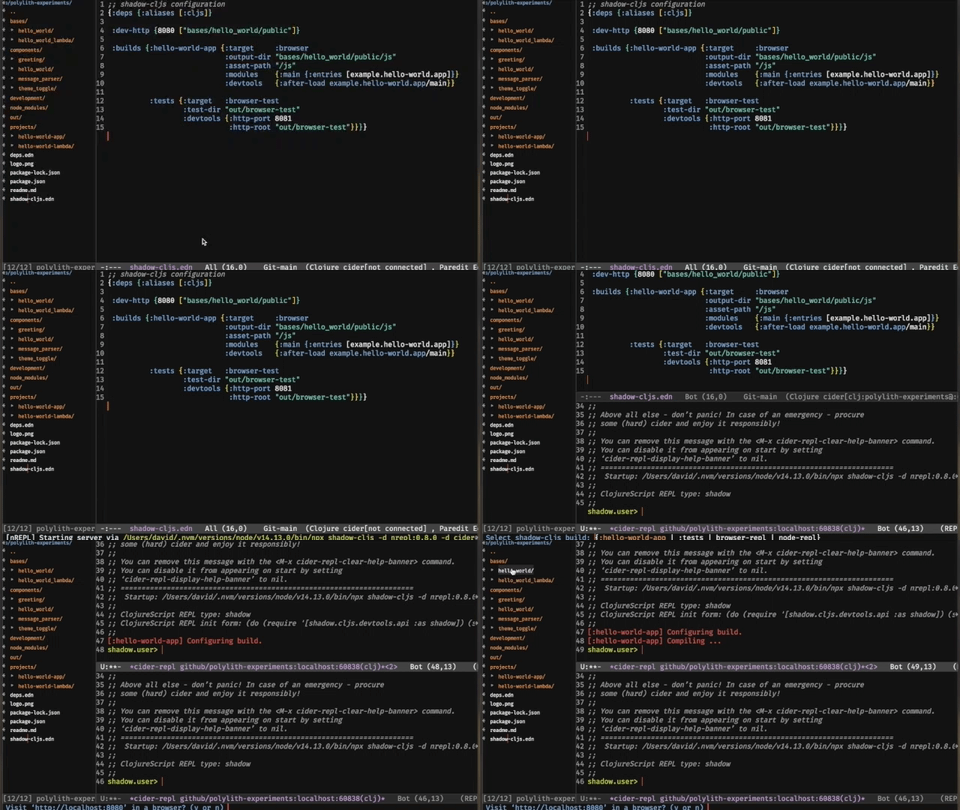
Well, we can have a two-REPLs experience. One for Clojure, that run on top of the JVM, and one for ClojureScript on top of JavaScript. Running both will make REPL driven backend development and Interactive Web Development possible.

You can add and use new ClojureScript components while the REPL is running. Create the namespace and evaluate the function.

There is one thing that I have no solution for (yet). When creating a new ClojureScript component and evaluating the entire namespace at once, I get a compilation error in the ClojureScript REPL: file not on classpath. The ClojureScript REPL have to be restarted to reload new source paths.

But don't worry, you can still evaluate the individual functions in the namespace and they will be loaded as expected in the ClojureScript REPL.

Tooling support

Polylith has a very nice and useful tool to support creating building blocks and to verify the setup. You can create components, bases and projects - as long as it is Clojure. For ClojureScript, you will have to create components manually.

If you are lazy, like me, just create a component with the poly tool as you would for Clojure, and simply rename the file extension to cljs or cljc afterwards.

Editor support?

Your editor most likely has support for running both Clojure and ClojureScript simultaneously. Emacs is my favourite editor. Start the REPLs with the cider-jack-in-clj&cljs command and you're ready to go!

Two REPLS running (even though the Cider splash message is confusing)

* The quote is from Joakim Tengstrands and Furkan Bayraktars talk about Polylith at the FuncProg Sweden 2020 meetup.

Photo by Amélie Mourichon on Unsplash